Turtle Wax Jet Black Review
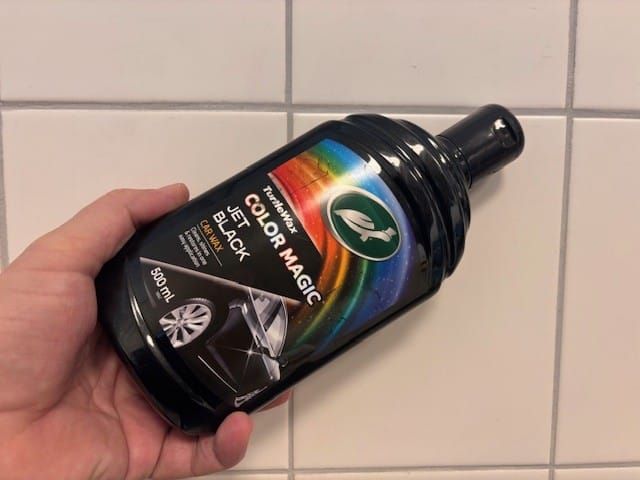
Before reviewing the product, I’d like to go over the instructions for use with you.
After all, using the product correctly has a huge impact on the final (lasting) result—and therefore on your experience.
Step-by-step instructions
- Wash the car thoroughly and dry it completely.
- Shake the bottle well.
- Apply a small amount to a clean, soft microfibre applicator pad.
- Work one panel at a time, spreading the polish evenly in overlapping circular movements.
- Allow it to dry to a light haze.
- Buff off with a clean, dry microfibre cloth until the paint shines.
- Repeat on the remaining panels.
Important
- Work in the shade.
- Never apply to hot paintwork.
- Don't use excessive product.
- Avoid glass, tyres and unpainted plastic.
- Don't let the product dry excessively before buffing.
For example, if you want to make your black roof rails look nice, feel free to repeat all the steps again. I replaced my chrome roof rails with used black ones from a junkyard (they looked like shit 😄) and carefully went through the process four times before installing them.
Eventually they looked like new. And even after a year, they still look great.
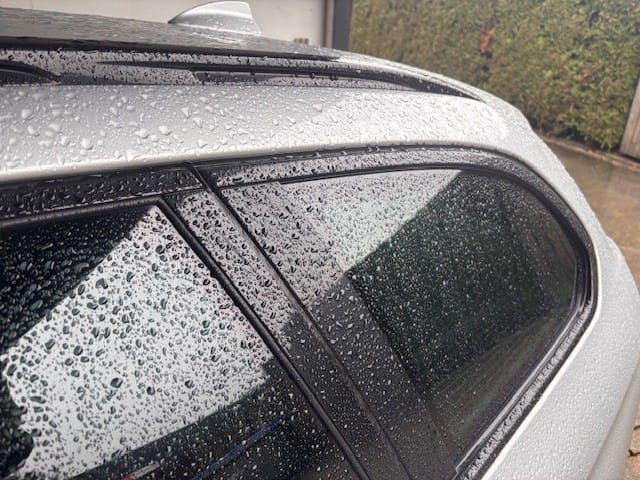
So before I go on to discuss the product further, I actually want to say: work with these kind of products—don't think it's just going to work for you on its own ;-)
I think this fact stands out even more with the spray version.
1. The traditional bottle: Turtle Wax Color Magic Jet Black
When discussing the traditional bottle version, one important distinction is that Turtle Wax has sold several black-paint products under closely related names. The conventional liquid product is commonly associated with the Color Magic Jet Black range, while the Jet Black Black Spray Wax is a separate product.
The traditional liquid wax is designed to restore the appearance of black paintwork while adding a protective wax layer. Its main selling point is the colour-enhancing formulation, which is intended to make black paint look richer, darker and more uniform.
Appearance and colour enhancement
The biggest attraction of a black-specific wax is its ability to improve the visual appearance of paintwork that has started to look tired.
Black paint can develop a slightly grey or washed-out appearance as it ages, particularly when exposed to sunlight, road grime, frequent washing and general environmental contamination. A colour-enhancing wax is designed to make the finish look richer and more vibrant.
The Jet Black approach uses colour pigments to help disguise minor imperfections and improve the apparent uniformity of the paint. This can be particularly useful on older black vehicles where the paint is not in perfect condition.
It is important, however, to understand the difference between hiding imperfections and actually correcting them. A coloured wax does not permanently remove scratches, and deeper scratches that have gone through the clear coat will not disappear. Its contribution is primarily cosmetic.
Gloss and finish
A good black wax should produce more than simply a shiny surface. Ideally, it should create a deep, reflective finish that makes the paint look smooth and well cared for.
This is where a colour-specific product can be attractive. The combination of wax and colour-enhancing ingredients is intended to give black paint a deeper appearance than a basic general-purpose wax.
On a well-maintained vehicle, the result should be particularly noticeable in daylight, where reflections become clearer and the paint looks more uniform.
Protection
The wax component also provides a degree of protection against water, dirt and environmental contamination.
Water beading is one of the most immediately noticeable benefits of a freshly waxed car. Instead of water spreading across the paint, it forms droplets that are easier to rinse away.
Nevertheless, this should not be confused with ceramic coating protection. Traditional waxes generally need more frequent maintenance and reapplication, especially on vehicles that are regularly driven, washed or parked outdoors.
Ease of use
The traditional liquid-wax format has an advantage for people who prefer a more conventional waxing routine.
You can control how much product you apply, work carefully around individual panels and spend extra time on areas that need attention.
The disadvantage is that it takes more effort than a quick spray product. You need to apply the wax evenly, allow it to haze if the instructions require it, and buff it off properly.
Applying too much product can also make removal harder and increase the likelihood of streaking.
Overall impression: The traditional bottle format is the better choice for someone who wants a more deliberate waxing session, colour enhancement and a protective finish rather than simply a quick gloss boost.
2. Turtle Wax Jet Black Black Spray Wax
The spray version is particularly interesting because it offers a different approach to maintaining black paintwork.
The older Jet Black Black Spray Wax, product code T11, was sold in a 473 ml bottle. It was developed specifically for black, metallic black, charcoal and similarly dark automotive finishes.
Unlike a conventional wax, the spray version is intended to make application much quicker while still delivering a noticeable shine and water-repellent finish.
Formula and technology
According to Turtle Wax's product literature, the original Black Spray Wax combines:
- Black-pigmented ingredients intended to mask minor surface blemishes.
- High-shine polymers to improve paint reflectivity.
- Carnauba wax to enhance gloss and water beading.
- UV protection intended to help reduce fading.
- Lubricating ingredients to help produce a smooth finish.
The black pigmentation is one of its most interesting features.
Rather than relying exclusively on a transparent layer of wax, the product uses a tinted formula intended to make dark paint appear richer and more uniform.
It is important not to expect miracles, though. It cannot permanently repair scratches or restore severely damaged clear coat. The effect is primarily a cosmetic enhancement.
Application and ease of use
One of the strongest advantages of the spray format is convenience.
You do not need to spend as much time working with an applicator pad as you would with a traditional liquid wax. You can spray the product onto the paintwork and distribute it with a clean microfibre cloth.
The recommended approach is to work on a clean, dry vehicle, treating manageable sections at a time. Using a second, clean side of the cloth for final buffing helps achieve a more even finish.
For regular maintenance, this is a particularly appealing format.
After washing a black car, a spray wax can be a convenient way to restore gloss and add a fresh layer of protection without turning the entire process into a lengthy detailing session.
Shine and water beading
The manufacturer's claims focus on a rich reflective shine and improved water beading.
Customer feedback generally supports the idea that the spray version can produce an attractive finish. On Canadian Tire, the related Jet Black black wax spray received an average rating of 4.1 out of 5 from 42 reviews, with 86% of recommending respondents saying they would recommend it.
Positive reviewers particularly mention:
- A noticeable improvement in black paint appearance.
- A deep, glossy finish.
- Good water beading.
- Relatively easy application.
- Good results when combined with other black-car detailing products.
One reviewer specifically commented that it brought back the black colour and produced excellent shine. Others reported good results when using it as part of their regular washing and waxing routine.
The downside: durability
Durability is where expectations need to be realistic.
An independent detailing review of the original T11 Black Spray Wax found that it enhanced the paintwork of a Toyota Vitz and provided good initial results, but its water-beading performance had diminished within approximately two weeks.
The reviewer described its durability as average and its value for money as good.
This is an important observation because it highlights the difference between an attractive finish immediately after application and long-lasting paint protection.
A spray wax is convenient, but it should not automatically be expected to last as long as a dedicated long-term paint sealant.
For somebody who washes their car regularly, this may not be a major disadvantage. Reapplication is relatively straightforward.
For someone who wants to wax a car once and forget about it for several months, it is less appealing.
Customer complaints
Not every customer has had a positive experience.
Some reviews mention disappointing results, and a few customers have reported problems with the spray product itself. There are also comments about instructions not being sufficiently clear.
Canadian Tire's review breakdown for the related Jet Black detailer spray is particularly revealing: 39 five-star reviews, seven four-star reviews, six three-star reviews, three two-star reviews and 13 one-star reviews, giving it an overall rating of 3.8 out of 5 from 68 reviews.
That is a fairly mixed result.
It suggests that the product can work very well for some owners but is not universally impressive.
It is also worth noting that the Black Spray Wax and the Black Detailer Spray are different products. Their customer ratings should not be treated as interchangeable.
3. The newer Jet Black Spray Polish – a different product
There is another product worth discussing: the Turtle Wax Jet Black Spray Polish, 500 ml, product code 53140.
This should not be confused with the older T11 Black Spray Wax. Although both are spray products intended for dark paintwork, their stated functions are somewhat different.
The newer Spray Polish is marketed as an all-in-one polish, wax and colour-enhancing product.
According to Turtle Wax, it combines synthetic waxes, black-pigmented polishing platelets and microfine polishing powders.
Its advertised benefits include:
- Increasing paint reflectivity.
- Enhancing the appearance of black paint.
- Removing or reducing the appearance of fine swirl marks.
- Helping remove water spots and paint contaminants.
- Providing a protective layer through synthetic polymers.
One particularly interesting claim is that its polymers bond to the clear coat to provide improved durability.
How to apply it
The manufacturer recommends the following procedure:
- Thoroughly wash and dry the vehicle.
- Shake the bottle well to distribute the polishing ingredients.
- Ensure the paintwork is cool and avoid direct sunlight.
- Spray onto a manageable section from approximately 15–20 cm away.
- Spread the product using a folded microfibre cloth and overlapping circular motions.
- Allow it to dry to a haze.
- Buff with a clean side of the microfibre cloth until a high gloss is achieved.
Working one panel at a time is particularly important. It gives you more control over the product and reduces the risk of uneven drying or residue.
What do customers think?
The available customer feedback is encouraging.
Car Parts 4 Less lists the Jet Black Spray Polish at 4.46 out of 5 based on 13 reviews.
Positive reviewers mention its attractive shine, reasonable price and ease of application.
One owner of a black Ford Capri and Sierra described it as a very good polish and found it useful as a quick detailer.
Another reviewer liked the shine but felt that the black colour enhancement was not particularly noticeable.
There is also a useful warning from a customer who experienced smearing when applying it to paint that had not been properly washed and dried.
This illustrates an important point: preparation matters. Even a convenient spray polish will not deliver its best results when applied over dirt, water or an unsuitable surface.
4. Bottle versus spray: which is better?
This is probably the most important question when deciding between the different Jet Black products.
Feature | Traditional liquid wax | Black Spray Wax | Jet Black Spray Polish |
|---|---|---|---|
Main purpose | Colour enhancement and waxing | Quick gloss and protection | Polishing, gloss and protection |
Application | Conventional waxing | Spray and wipe | Spray, work and buff |
Black pigments | Depends on formulation | Yes | Yes |
Carnauba | Depends on formulation | Yes | Blended synthetic waxes |
Fine swirl reduction | Primarily cosmetic filling | Primarily cosmetic filling | Microfine polishing ingredients |
Water beading | Expected | Expected | Expected |
Convenience | Moderate | Excellent | Very good |
Best use | More deliberate waxing | Maintenance between washes | Improving the appearance of tired paint |
The table is a comparison of product positioning rather than a laboratory comparison of measured performance. Exact ingredients and protection levels vary between formulations.
Which gives the deepest shine?
For somebody who owns a black car, the most important result is usually the final appearance.
The traditional wax offers the more conventional approach to achieving a rich finish. It is suitable for people who enjoy spending time on their vehicle and prefer a dedicated waxing session.
The Black Spray Wax is more about convenience. It offers an easy way to refresh the finish and maintain the appearance of a previously waxed vehicle.
The Spray Polish is arguably the most interesting of the three because it combines colour enhancement with polishing ingredients. It is designed to do more than simply leave another layer of wax on the paint.
However, none of these products should be expected to deliver the same correction as a proper machine polish.
Which is easiest to use?
The Black Spray Wax wins here.
It is designed to make maintenance straightforward, and it is particularly suitable for people who want to spend less time detailing their vehicles.
The Spray Polish takes slightly more care because you need to distribute the polishing ingredients evenly and allow the product to haze before buffing.
The traditional liquid wax is the more time-consuming option.
Which offers the best protection?
This is harder to answer definitively because there are no directly comparable independent durability tests covering all three products.
The original Black Spray Wax has independent feedback suggesting that its water beading can decline after approximately two weeks.
The newer Spray Polish makes stronger claims about polymer adhesion and durability, but marketing claims should not be mistaken for independently verified performance figures.
I would therefore treat all three as maintenance products rather than substitutes for a dedicated ceramic coating or long-lasting paint sealant.
5. My overall verdict
Turtle Wax Jet Black is an interesting range because it addresses a genuine problem for black-car owners.
Black paint can be difficult to maintain, and products that improve its depth, gloss and visual uniformity are always welcome.
The traditional bottle version has appeal for people who prefer a more conventional waxing process. It provides a way to enhance the colour and add a protective finish, although it cannot permanently correct paint defects.
The original Black Spray Wax is particularly attractive for regular maintenance. Its ease of use, carnauba-based formulation and colour-enhancing ingredients make it a convenient product to keep in the garage. The main compromise is that its protection should not be expected to last indefinitely.
The newer Jet Black Spray Polish is arguably the most versatile option. Its combination of polishing powders, colour-enhancing pigments and synthetic polymers makes it an appealing choice for black paint that needs a little more attention than a simple spray wax can provide.
My recommendation would be:
- For a traditional waxing session: Choose the liquid wax.
- For quick maintenance after washing: Choose the Black Spray Wax.
- For improving the appearance of slightly tired black paint: Choose the newer Jet Black Spray Polish.
Ultimately, I think the biggest strength of the Jet Black range is its focus on dark paintwork rather than trying to be a universal solution for every vehicle colour.
It is not professional paint correction, and it is not a replacement for a ceramic coating. Nevertheless, for somebody who enjoys maintaining a black car and wants a richer-looking finish without spending a fortune on professional detailing products, the range is worth considering.
I would particularly recommend paying attention to preparation. A thoroughly washed, properly dried and cool surface will make a considerable difference to the final result, regardless of which product you choose.
Overall assessment: A worthwhile budget-friendly range for black-car maintenance, with the newer Spray Polish being the most interesting all-rounder.
If you apply the wax from the traditional bottle and use it (repeatedly!) according to the instructions, you'll get the best lasting results.